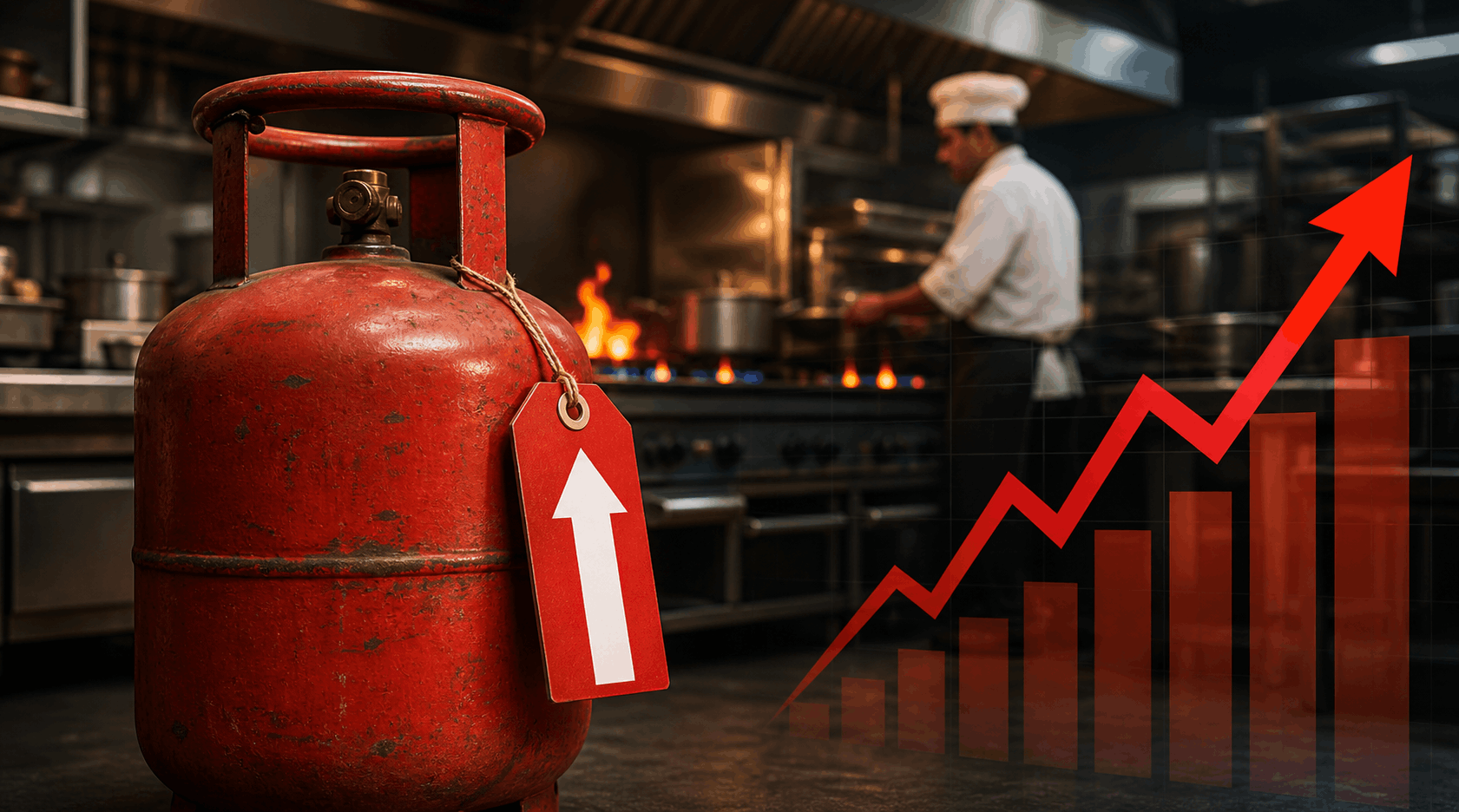
In a significant development affecting the hospitality and food service sectors, oil marketing companies (OMCs) announced a steep increase in the commercial cylinder price effective May 1, 2026. A 19 kg commercial LPG cylinder now costs ₹3,071.50 in the national capital, up from ₹2,078 – a jump of ₹933 per cylinder. This decision comes amid escalating geopolitical tensions in West Asia and a sharp rally in international crude oil prices, which touched a four-year high earlier this week.
However, in a move aimed at shielding millions of households from inflationary pressure, state-run fuel retailers have kept domestic LPG cylinder prices (14.2 kg), along with petrol and diesel rates, unchanged across the country. Aviation Turbine Fuel (ATF) prices for domestic airlines have also been left untouched. The government and OMCs have described the intervention as a “calibrated and balanced approach” to align with global market trends while ensuring economic stability for the majority of consumers.
📊 Need to calculate the financial impact of this price hike? Use our free Percentage Calculator to quickly find out how much more you will pay per cylinder. Visit: drtool / Percentage Calculator
Commercial Cylinder Price Rises Sharply in Delhi – What It Means for Businesses
The revised commercial cylinder price directly impacts hotels, restaurants, canteens, small eateries, banquet halls, and other commercial establishments that rely on 19 kg LPG cylinders for daily operations. With the new pricing structure, a commercial cylinder in Delhi will cost ₹3,071.50, reflecting a ₹933 increase from the previous rate of ₹2,078.
This price revision, implemented by Indian Oil Corporation Limited (IOCL) and other OMCs, is part of routine monthly adjustments based on international benchmarks. While households have been spared, the commercial segment – which accounts for less than 1% of India’s total petroleum consumption – has borne the brunt of rising import costs.
Why the hike now?
Global crude oil prices have surged dramatically. Brent crude futures climbed to 126.41perbarrelonThursday,thehighestlevelsinceMarch9,2022,whileWTIcrudetouched110.93 before settling slightly lower. The primary triggers include fresh tensions in West Asia and a continued blockade of the Strait of Hormuz – a vital energy chokepoint through which nearly 40% of the world’s seaborne oil passes. India, importing around 88% of its crude requirements, relies on this route for approximately 90% of its LPG imports.
The OMCs have clarified that the commercial cylinder price adjustment affects only industrial and commercial users. Bulk LPG and commercial cylinders form a minuscule share of overall fuel consumption, allowing the government to limit the pass-through to end consumers.
Domestic LPG, Petrol, Diesel Rates Remain Unchanged – Major Relief for Households
While commercial users face higher costs, ordinary consumers have reason to stay relieved. In its official statement, IOCL confirmed that retail prices of petrol, diesel, and domestic LPG (14.2 kg cylinders) have not been revised. This means that around 33 crore domestic LPG customers will continue to pay the same price for their cooking gas cylinders.
Similarly, petrol and diesel prices remain stable for the general public, which accounts for nearly 90% of total fuel consumption in the country. The government has also left ATF prices unchanged for scheduled domestic airline operations, providing some respite to the aviation sector which is still recovering from past fuel cost volatility.
Key takeaway for households:
Despite global crude oil touching a four-year high, Indian consumers will not see any immediate increase in their monthly fuel or cooking gas bills. According to IOCL, approximately 80% of all petroleum products have witnessed no price change. That includes petrol, diesel, domestic LPG, and ATF for domestic flights.
The company’s press note emphasized that the price revisions have been “limited to select industrial segments which form a small share of overall consumption,” and that these are subject to routine monthly adjustments. This selective approach has helped insulate the broader population from global price shocks.
🧾 Business owners and finance readers: Quickly estimate your new monthly expenses or tax impact using our GST Calculator. It’s fast, accurate, and free. Find it on drtool – GST Calculator.
Global Crude Surge and the Strait of Hormuz Crisis – Understanding the Pressure
To fully grasp why the commercial cylinder price has gone up, it is essential to look at what is happening in international energy markets. Crude oil prices have been rising sharply over the past few weeks, but the latest escalation came after fresh geopolitical flare-ups in West Asia.
Brent crude, the international benchmark, surged to 126.41perbarrel–alevelunseeninoverfouryears.∗∗WTIcrude∗∗alsojumpedto110.93 before pulling back slightly. By 8:27 AM IST on May 1, Brent was trading around 112perbarrel,whileWTIhoverednear106.2.
The primary reason for this volatility is the continued blockade of the Strait of Hormuz, a narrow waterway between the Persian Gulf and the Gulf of Oman. Nearly 40% of globally traded crude oil passes through this strait, along with 50% of liquefied natural gas (LNG) and a significant share of LPG. Any disruption in this corridor directly impacts energy prices worldwide.
India, being heavily dependent on imports, is particularly vulnerable. The country sources roughly 88% of its crude oil needs from overseas, with a large portion transiting through the Strait of Hormuz. For LPG specifically, about 90% of imports use this route. This explains why OMCs have been forced to adjust prices for commercial cylinders, even while protecting domestic users.
Government Cuts Windfall Gains Tax on Diesel and ATF Exports
In a parallel development aimed at managing fuel export dynamics, the Finance Ministry has reduced the windfall gains tax on exports of diesel and ATF, effective May 1, 2026. The special additional excise duty on diesel exports has been cut from ₹55.5 per litre to ₹23 per litre. For ATF, the duty has been reduced from ₹42 per litre to ₹33 per litre.
Additionally, the government has set the road and infrastructure cess on diesel exports to nil for the next fortnight starting May 1. However, there will be no change in excise duty rates on petrol and diesel meant for domestic consumption.
This move is significant because it reflects the government’s effort to balance domestic availability with export competitiveness. Earlier, on March 26, export duties of ₹21.50 per litre on diesel and ₹29.5 per litre on ATF were imposed. These were later increased to ₹55.5 per litre and ₹42 per litre respectively in a review on April 11. The latest reduction suggests a recalibration based on changing global price dynamics.
From a consumer perspective, this adjustment does not directly affect retail fuel prices. However, it signals that the government is actively monitoring the situation and is willing to tweak taxes to prevent undue windfall gains for refiners while ensuring that domestic supplies remain secure.
How OMCs Are Managing the Crisis
Indian Oil Corporation Limited, in its press note, outlined a clear strategy: protect the mass consumer while passing on global price signals only to industrial segments that can absorb or manage such fluctuations. The company stated, “Overall, approximately 80% of petroleum products have witnessed no change in prices, ensuring stability for the majority of consumers.”
The products that have seen upward revisions include:
- Bulk LPG and commercial LPG cylinders (less than 1% of total consumption)
- Bulk diesel for certain industrial users
- ATF for international airline operations
This targeted approach is not accidental. By insulating petrol, diesel, and domestic LPG – products used by hundreds of millions of Indians – the government aims to prevent a broad-based inflationary spiral. At the same time, allowing the commercial cylinder price to move with international benchmarks ensures that OMCs do not suffer large under-recoveries.
The Ministry of Petroleum and Natural Gas has been guiding OMCs to adopt a “calibrated approach” that aligns domestic pricing with global trends without shocking the common citizen. The current round of revisions is a textbook example of that philosophy in action.
Furthermore, the government has reassured citizens that domestic LPG supplies remain secure despite the Strait of Hormuz blockade. India has been diversifying its crude and LPG import sources in recent years, including increased purchases from other regions. However, the sheer volume of trade passing through West Asia means some price impact is inevitable.
💰 Planning to take a loan to manage business expenses after the LPG price hike? Use our EMI Calculator to check your monthly repayments before applying. Visit: drtool – EMI Calculator.
Conclusion
The latest revision in the commercial cylinder price by ₹933 per cylinder underscores the delicate balancing act that Indian oil marketing companies and the government must perform in times of global energy turmoil. With crude oil prices touching a four-year high and the Strait of Hormuz blockade threatening vital supply routes, the pressure on import-dependent India is real.
However, by shielding domestic LPG, petrol, and diesel from price hikes, policymakers have ensured that nearly 80% of consumers face no immediate impact. Hotels, restaurants, and other commercial users will have to absorb the higher cost, but for ordinary households, cooking gas and transportation fuel remain stable.
The reduction in windfall taxes on diesel and ATF exports further highlights the government’s proactive approach to managing both domestic stability and export competitiveness. As global geopolitical tensions continue to evolve, Indian consumers can take some comfort in knowing that OMCs are prioritizing mass protection over broad-based price pass-through.
For now, the message is clear: the commercial cylinder price may have gone up, but the common citizen’s monthly budget for fuel and cooking gas remains untouched – at least for this cycle. Whether this stability can be maintained if crude prices climb further remains to be seen. But as of May 1, 2026, the government has delivered a significant relief to the vast majority of Indians.